Rules:
- Player rolls to traverse the board according to the number rolled (ie rolling a 4 = player moves 4 spaces)
- Once movement has ended, player can choose to either A) Consume one pickaxe and examine the space they have landed on, or B) Draw and use one Equipment Card
- If the player examines a space and finds a Diamond, that Board Card is removed from play, and added to said players’ inventory. After this turn, players may not use this space as part of the board and must travel around the space.
- If the player examines a space and finds an Emerald and also holds the FIND EMERALD Equipment Card in their inventory, the space is treated as a Diamond Space, and follows the same protocol. If the player who finds the Emerald does NOT have the FIND EMERALD Equipment Card in their inventory, this space is treated as a blank space, and the turn is over.
- If the player examines the space and the space is blank, the Board Card is returned to its location and the turn is over.
- If the player draws and uses an equipment card, It must be used and the action must be completed immediately. You may not store equipment cards in your inventory (Other than the FIND EMERALD Equipment Card.)
- Once the player has either examined the space or used an equipment card, the turn is over, and the next player can go.
- Each player has 5 pickaxe examination counters. As such, players can only examine 5 unique spaces. If a player uses all 5 of their pickaxe examination counters to examine the board, their search has ended, and the opposing player wins by default, regardless of how many diamonds each of the players have.
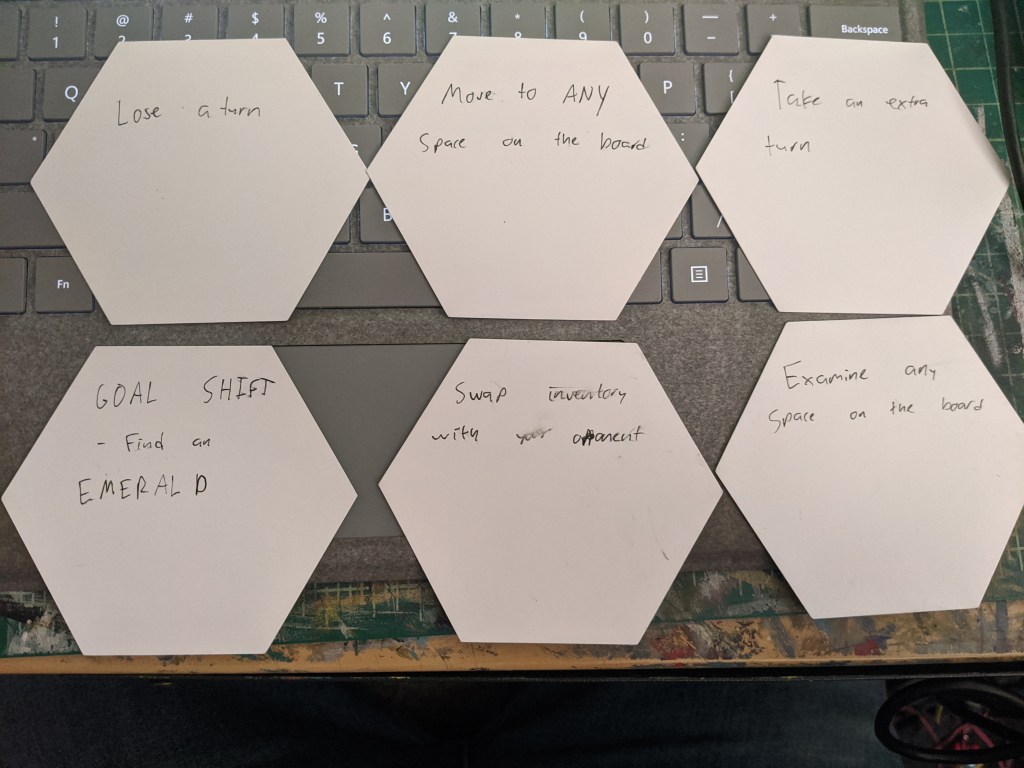
- The FIND EMERALD Equipment Card is a special equipment card found within the Equipment Card deck. If a player obtains this card during their Equipment Card phase, they gain an alternate win condition: Find an Emerald in the playing field. A player with the FIND EMERALD Equipment Card can choose to win either by finding the Emerald OR by finding the 3 Diamonds, whichever they can accomplish first.
Example of Play:
Player 1 rolls a 3. They move 3 spaces to an unmarked hexagonal space. They choose to utilize one of their 5 pick axes to examine the space they landed on. The player examines the other side of the Board Card, without showing their opponent. It is blank. The player returns the Board Card back to its space and discards their pickaxe. Their turn has ended.
Player 2 rolls a 4. They move 4 spaces to a different space. They do not use a pickaxe, and instead draw an equipment card. The equipment card allows them to examine any space on the board. They pick 1 random space, and examine the other side of the Board Card without showing player 1. This Board Card contains a diamond. They replace the Board Card in its original space. Player 2 will spend their next turn travelling to the space they examined to obtain the diamond.
Inventory Required:
18 Hexagonal Game Board Cards
5 Diamond Cards
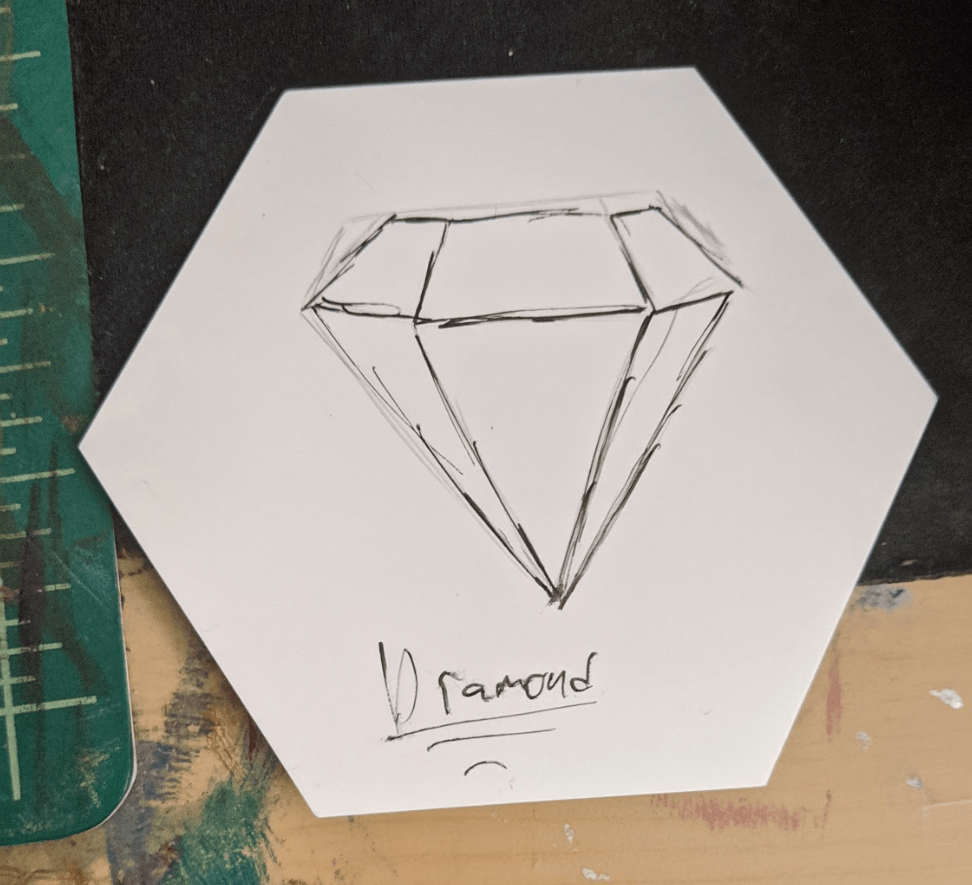
2 Emerald Cards

11 Blank Board Cards
10 Equipment Cards (2 of Each)
2 Player Pieces
2 Player PickAxe Counters
1 6 Sided Die
Paper Prototype Analysis:
Kick The Rock For Wild Canyon
Number of Players: 2
Suggested Player Age: 8 and Up
Introduction: As lifelong Treasure Hunting rivals, you and your opponent must scour the Wild Canyon for the last 3 diamonds in the field. Can you find the diamonds and complete your excavation before your opponent?
Summary of Game System/ Objectives: This treasure hunting game is a turn based, map exloration game, where players take turns examining spaces on the map in order to find the various diamonds hidden throughout the map.
Components of the Game:
17 Hexagonal Game Board Cards
5 Diamond Cards
2 Emerald Cards
10 Blank Board Cards
10 Equipment Cards
2 Player Pieces
2 Player PickAxe Counters
1 6 Sided Die
Set Up:
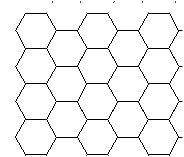
The 17 board cards are placed adjacent to each other in a random order. The Diamond and Emerald cards are scattered among the other 10 blank cards, all of which are placed face down to conceal the spaces. The two player pieces are placed on opposite ends of the board.
The Board’s organization should be alternating vertical rows of 4 and 3. (Picture attached)
Basic Game Structure:
Players take turns rolling the die, the player with the higher roll goes first. Turns are
Specific Game Structure:
In a single turn players should 1) Roll for movement, 2) move their piece, and 3) Either examine the space they landed on, OR draw one equipment card. If the player chooses to examine the space, they use up one of their five pick axes. If a player uses up all of their pick axes, they automatically lose.
Ending the Game: Players end the game by either A) Finding Three diamonds before their opponent (Resulting in a win), or B) Using up all of their pickaxes (Resulting in a loss)
Rules
 Josh's Game Studies Blog