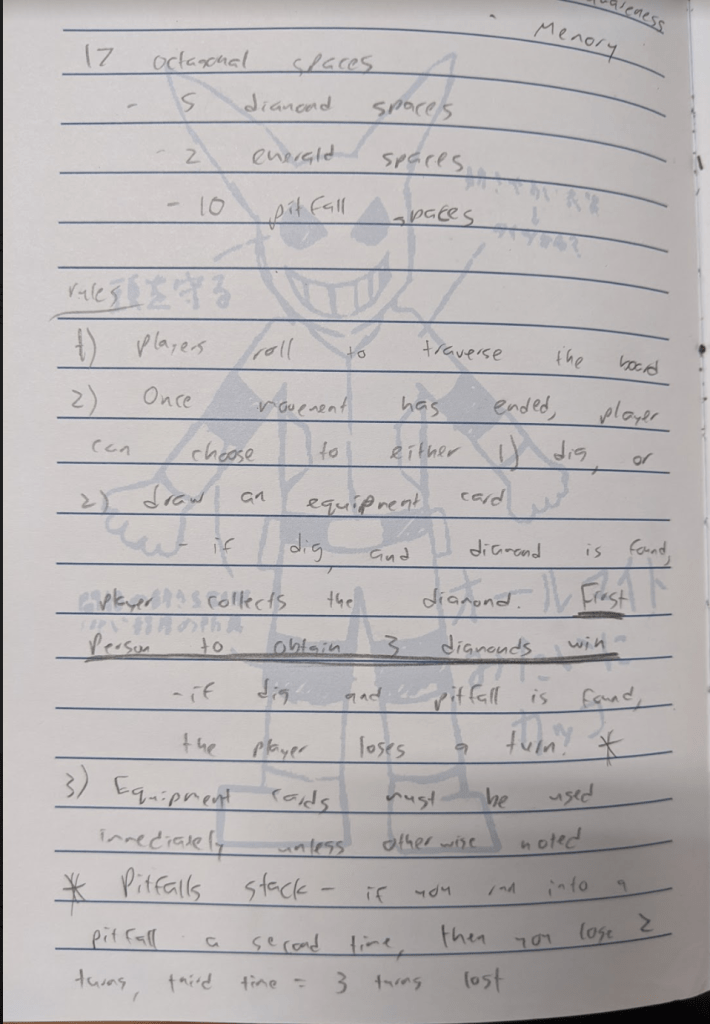
“Kick the Rock for Wild Canyon” is a map exploring treasure hunting game where players must examine spaces on the board for 3 diamonds. Players move to different spaces, and can decide whether to mine their space for a diamond and potentially suffer consequences, or play it safe but allow your opponent to claim the diamonds before you. The main mechanic used is the hexagon grid mechanic, used as a way to explore the map!
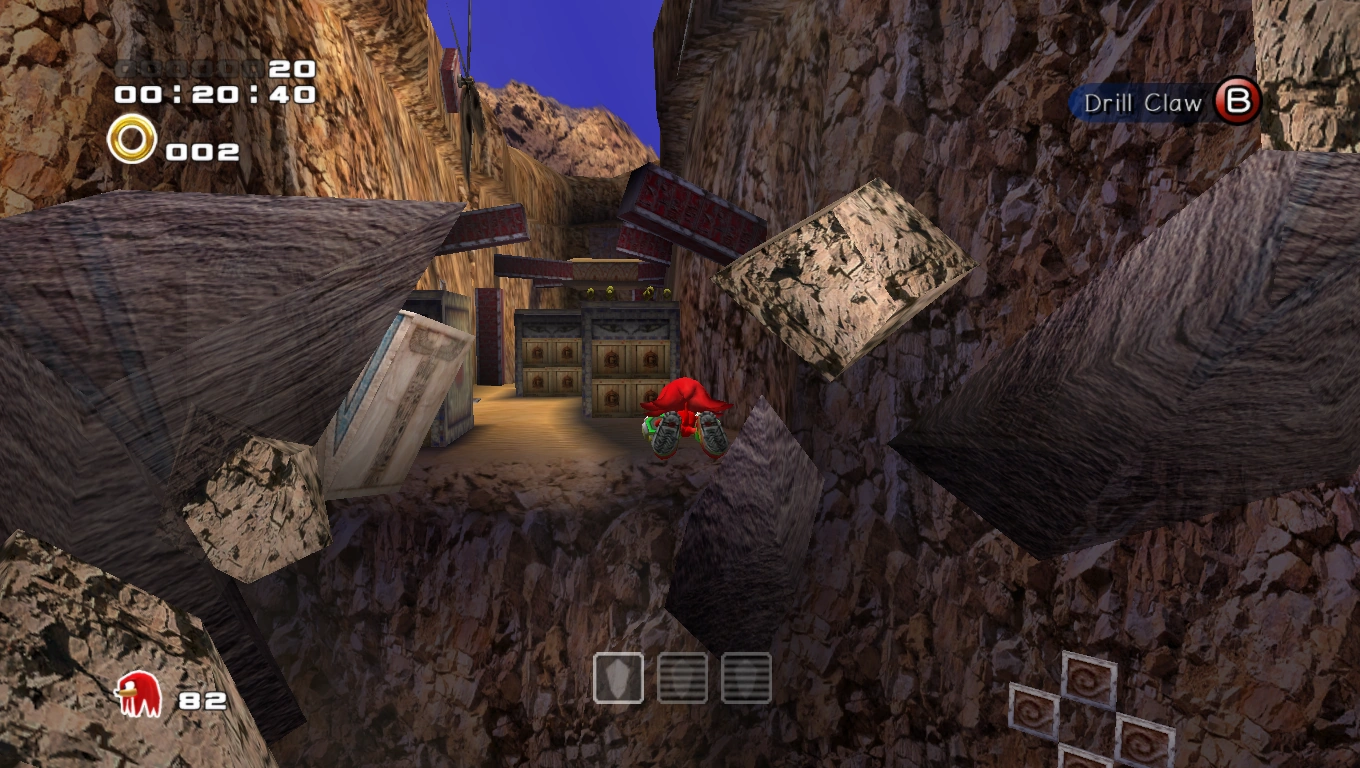
It is almost entirely based off of the treasure hunting levels in Sonic Adventure 2!
Playtest #1
Our first play through was to basically establish our main mechanics: Treasure hunting, event cards and basic movement. The play was very short, as the spaces were not randomized. I would roll the dice, and attempt to find a space that had a diamond within it. My partner would do the same on his turn. There were event cards that we designed and spread throughout the boards, but neither of us really ran into them to be able to use them, we were more focused on trying to find diamonds. These cards included things such as losing a turn, dropping inventory, and searching additional spaces. There wasn’t really a consequence for finding a diamond, and it didn’t feel like you did better than the opponent. I ended up winning, but I knew there was more work to be done to make the game feel complete.
Playtest #2
My second playthrough was when things got significantly more structured. I played with my little brother, age 11. Instead of scattering event cards throughout the actual playing field, I removed them and created a deck of that could be drawn from. In its place, I created punishment for investigating spaces: if you did not find a diamond, you would have to lose your next turn as well. This made it riskier to actually search for diamonds, and also incentivized actually using event cards. In this version, instead of searching a space, you could instead draw an event card, which could be good or bad. In this session, it was much more tense, and you were actively trying to examine spaces before your opponent could. Another thing I had to change was the amount of diamonds present on the board. In the first playtest, there were 3, but after some thought I increased the amount to five, which accounts for scenarios where both you and your opponent each find a diamond.
Playtest 3:

The third playthrough introduced a health system: You can now only investigate 5 spaces in your entire playthrough. We changed this in order to provide a sense of danger. In this playthrough the event cards were more utilized, and they ended up being a really pivotal part of the game. The biggest factor was a fear of having the “swap inventory” card get drawn, which would turn the game completely around. In this session, I would start with movement, but almost exclusively used event cards during my turn instead of mining. My opponent opted for a more active playstyle, and would mine every space he was allowed to. I found 2 diamonds with my more conservative play, but was turned against me after I drew the swap inventory card, which gave both of them to my opponent. Earlier in the game, I used an examine card to find a diamond, but was not allowed to obtain it until the next turn. My opponent took advantage of this situation, and remembered where the last diamond was, and used his last turn to win the game.
Overall the game is in a much more interesting spot now! I’m happy it got to where it was.
 Josh's Game Studies Blog